Train of Four 2.0: from a seismometer app to a medical journal
In April 2014 Kiichi got an email from Ratan Banik, then an anesthesia resident in the Bronx. He liked iSeismometer, the app that turns an iPhone into a seismograph, and he had an idea for it.
At the end of an operation, the anesthesiologist has to know that the drug that relaxed the patient’s muscles has worn off before the breathing tube comes out. The standard check is a train of four: a nerve stimulator on the wrist sends four small pulses, half a second apart, and the thumb twitches four times. If the drug is still working, the twitches fade: the fourth is weaker than the first. The ratio of the two, T4/T1, is the number the guidelines ask for. Stimulators are everywhere. The monitors that measure the ratio are not, and without one people count twitches by eye, which is not good enough.
Ratan’s idea was simple. The phone already has an accelerometer, and iSeismometer already drew what it felt on scrolling paper. Strap the phone to the patient’s palm, and the thumb’s twitch is a small earthquake.
Kiichi built it that summer. Train of Four went on the App Store in 2015, free, and quietly stayed there.
Eleven years later, a paper
This September I wrote to Ratan about the new iSeismometer, and he replied with a PDF. He and Michael Todd, both at the University of Minnesota’s Department of Anesthesiology, had done the study: 22 adults recovering from rocuronium, the iPhone strapped to one hand, a commercial acceleromyograph (a Stimpod 450) on the other, both stimulated every 20 seconds until full recovery. It is published in the Canadian Journal of Anesthesia: Banik, Takeuchi, Todd, 2026;73:313–315.
Across 141 paired readings the phone and the Stimpod agreed on average, a mean difference of −0.04. The authors are careful, and so are we: they write that the app should not be viewed as a replacement for validated monitors, and that when the phone reads 0.9 or more the Stimpod disagreed often, but that at 1.1 or more the chance of wrongly concluding full recovery “appears substantially reduced compared with reliance on PNS or clinical signs alone”. Where there is no monitor at all, that is a real step up from counting by eye.
2.0: the same measurement, everything else new
A paper is about a method, so the first rule for 2.0 was that the method does not move. The phone reads the accelerometer 100 times a second, removes gravity with the same filter, and measures four columns of half a second each, exactly as the 2015 app did. We ported the original code line by line and ran both over the same recording of 36 trains: 34 gave identical ratios, and the other two differed only because the 2015 columns crept a few milliseconds late at each edge.
Everything around it is rebuilt on the new iSeismometer’s code, which is where it came from in the first place.
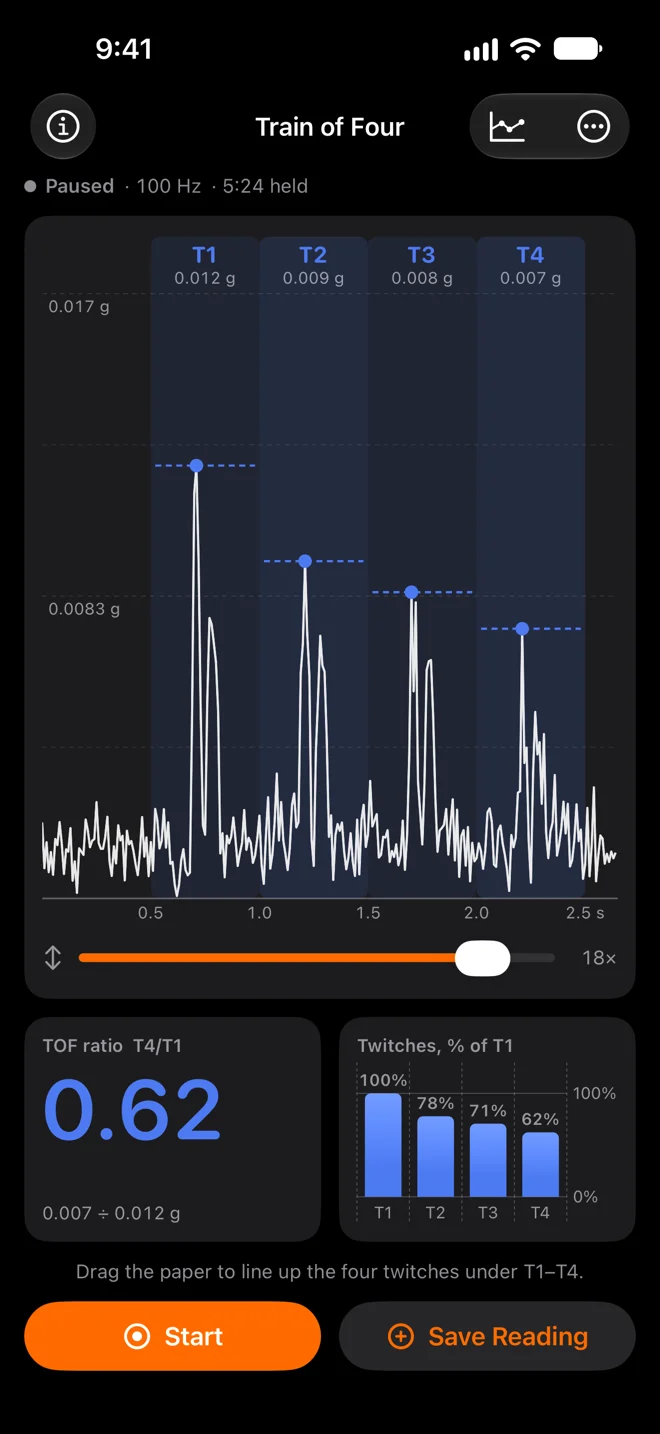
- The paper shows the four columns as bands, marks the peak of each twitch and gives it in g, and times the column edges underneath.
- T4/T1 has two decimals now (the study’s cut-off is 1.1, and one decimal could not tell 1.05 from 1.14), with the two numbers it is made of right under it.
- The fade is drawn as four bars, the way monitors show it.
- Scroll back through the last ten minutes while it keeps recording, and jump back to live.
- The status line shows how many samples a second the sensor is really delivering.
Readings across the whole reversal
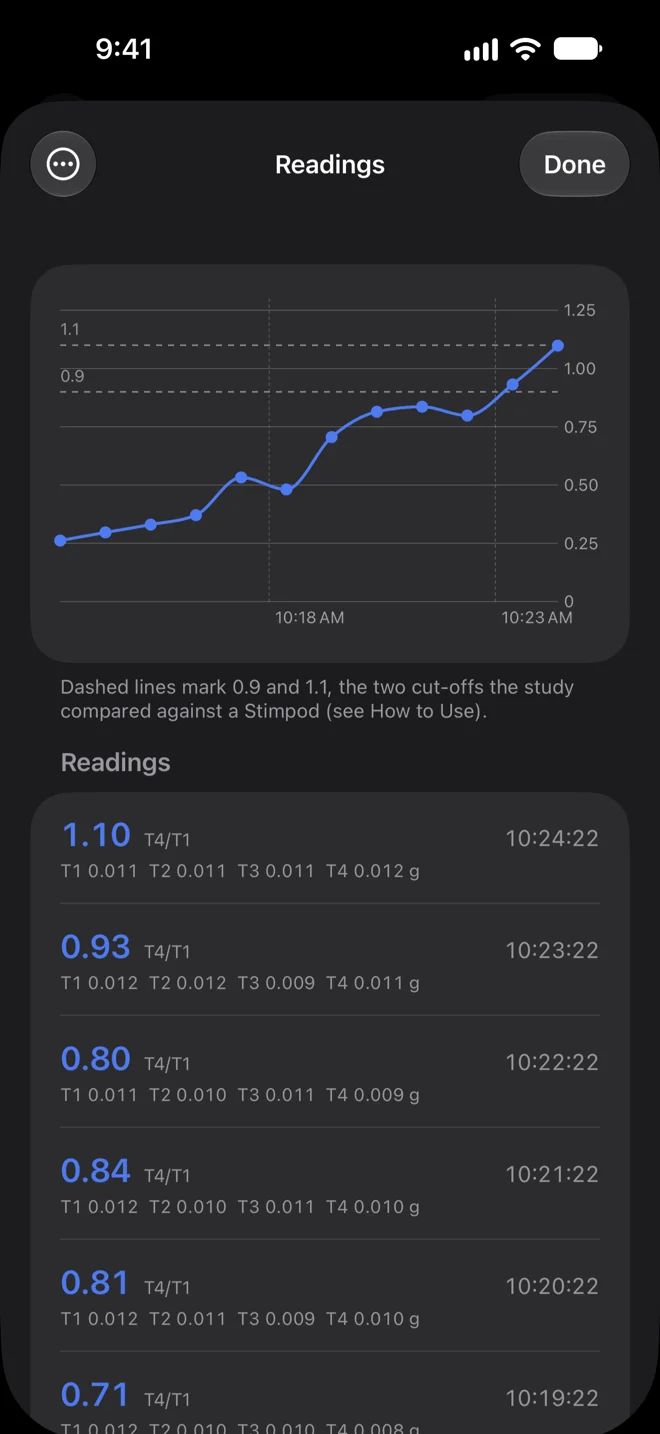
Tap Save Reading when a train sits under the columns, and the app keeps the ratio, the four peaks and the time. The Readings chart shows the ratio climbing as the patient recovers, with plain lines at the two values the study compared. Everything, the readings and the raw accelerometer data, exports as CSV files, for anyone who wants to do their own analysis.
How to Use in the app walks through the palm strap (with the Minnesota team’s own video), states the method in five lines, and gives the study with its numbers and its caution. Ratan tested 2.0 on TestFlight and approved the words that describe his study before anything went to the store.
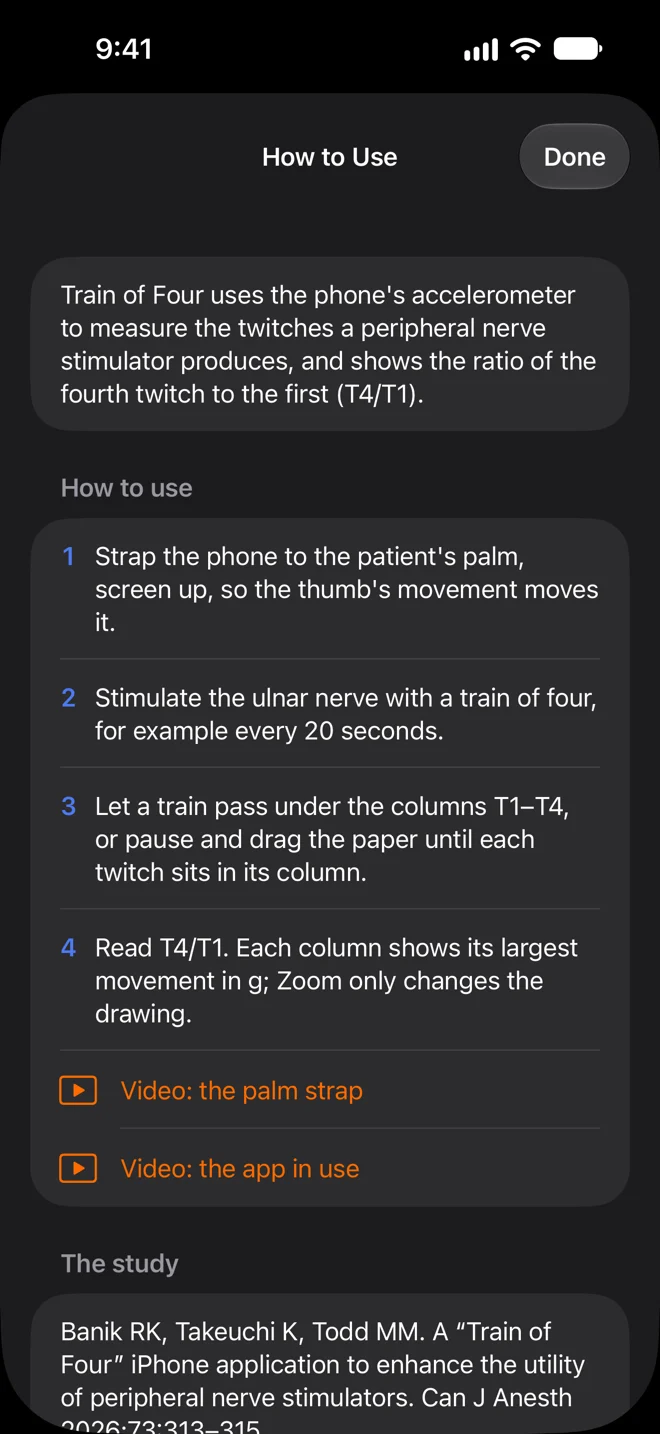
The screenshots here show demonstration data, not a patient.
Train of Four is still free, with no account and no ads, and the recording never leaves the phone unless you export it. It runs on iPhones back to iOS 16, because the point of the study is places where the equipment is old or missing. There is a page for it at objectgraph.com/trainoffour.
Thank you, Ratan, for the idea in 2014 and for the paper in 2026, and to Kiichi, who wrote the first version.